🧾 Definition and Basics
Fan blades rotate to move air, creating wind.
The strength, area, and noise of the wind depend on the number of blades, blade length, speed, and angle.
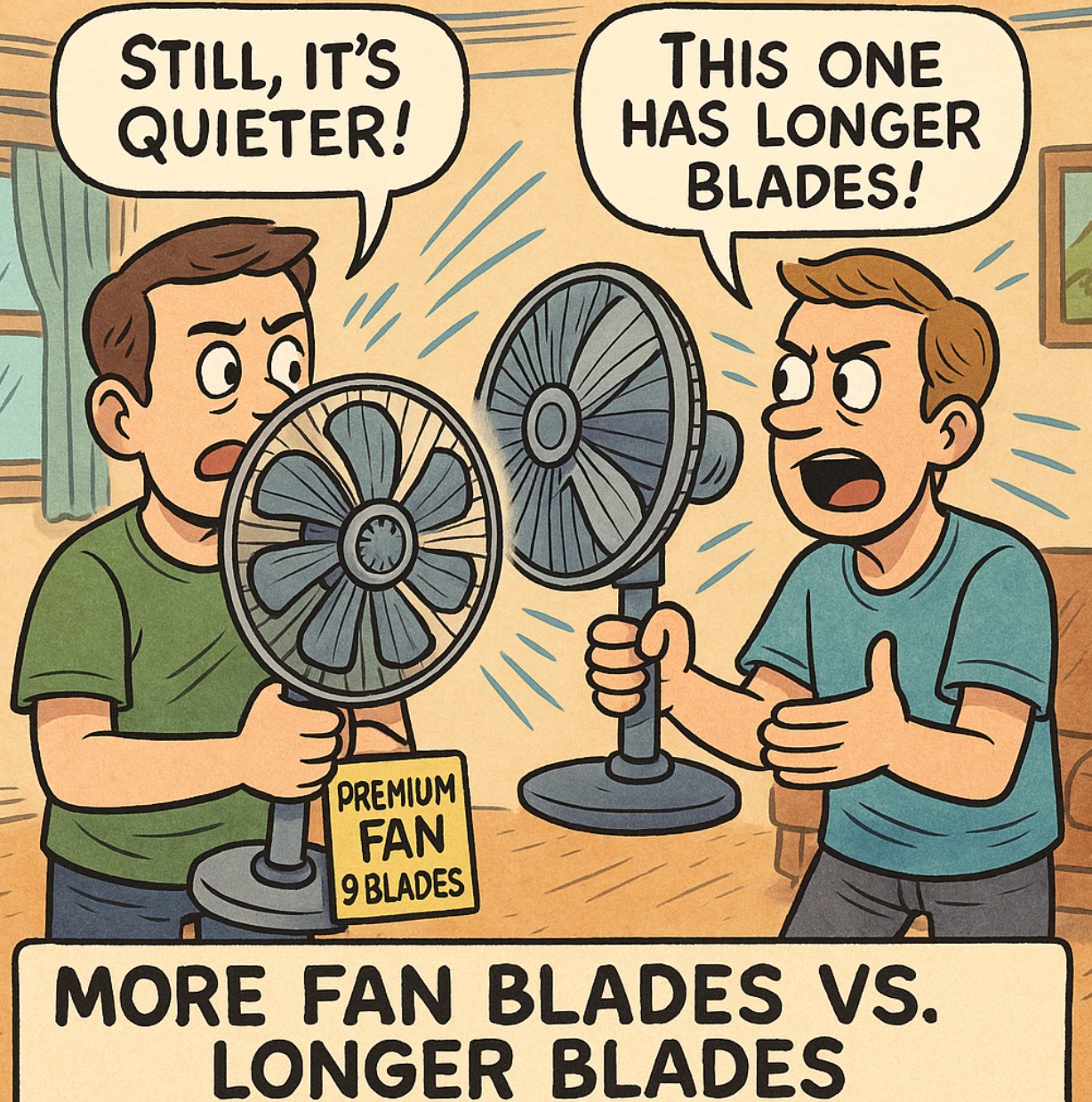
🌀 Benefits of More Blades
Pros:
-
Produces smoother and more stable airflow
-
Less noise, even at lower speeds
-
Often found in premium fans (7 to 9 blades)
Cons:
-
Higher air resistance, requiring more motor power
-
Increased electricity use
-
More expensive to manufacture
📏 Benefits of Longer Blades
Pros:
-
Covers larger areas with more air volume
-
Moves more air at the same speed
-
Quieter operation with slower rotation
Cons:
-
Larger fan size
-
Not ideal for tight spaces
-
Can be more prone to vibration
🤔 So Which Is Better?
| Situation | More Blades | Longer Blades |
|---|---|---|
| Quiet airflow | ✅ | ✅ |
| Large room | ❌ | ✅ |
| Compact size | ✅ | ❌ |
| Strong airflow | ❌ | ✅ |
| Premium feel | ✅ | ✅ |
In short:
-
For a quiet, smooth breeze → choose more blades
-
For strong wind in large areas → choose longer blades
🧠 Fun Facts
-
Dyson’s “bladeless” fan still hides an internal fan inside.
-
Military fans use long, fewer blades for strong air propulsion.
-
3–5 blades = budget models, 7–9 blades = premium segment.
🌍 International Trends
-
🇯🇵 Japan: Quiet fans with 8–9 blades are popular
-
🇺🇸 USA: Simpler 3–5 blade strong wind fans
-
🇪🇺 Europe: Circulator-style fans with long blades are also trending
🎯 Conclusion
-
More blades = smoother, quieter airflow
-
Longer blades = stronger wind, wider coverage
Pick your fan based on your space, sound preference, and airflow needs!
Tags: fan blades, number of blades, blade length, air volume, fan noise