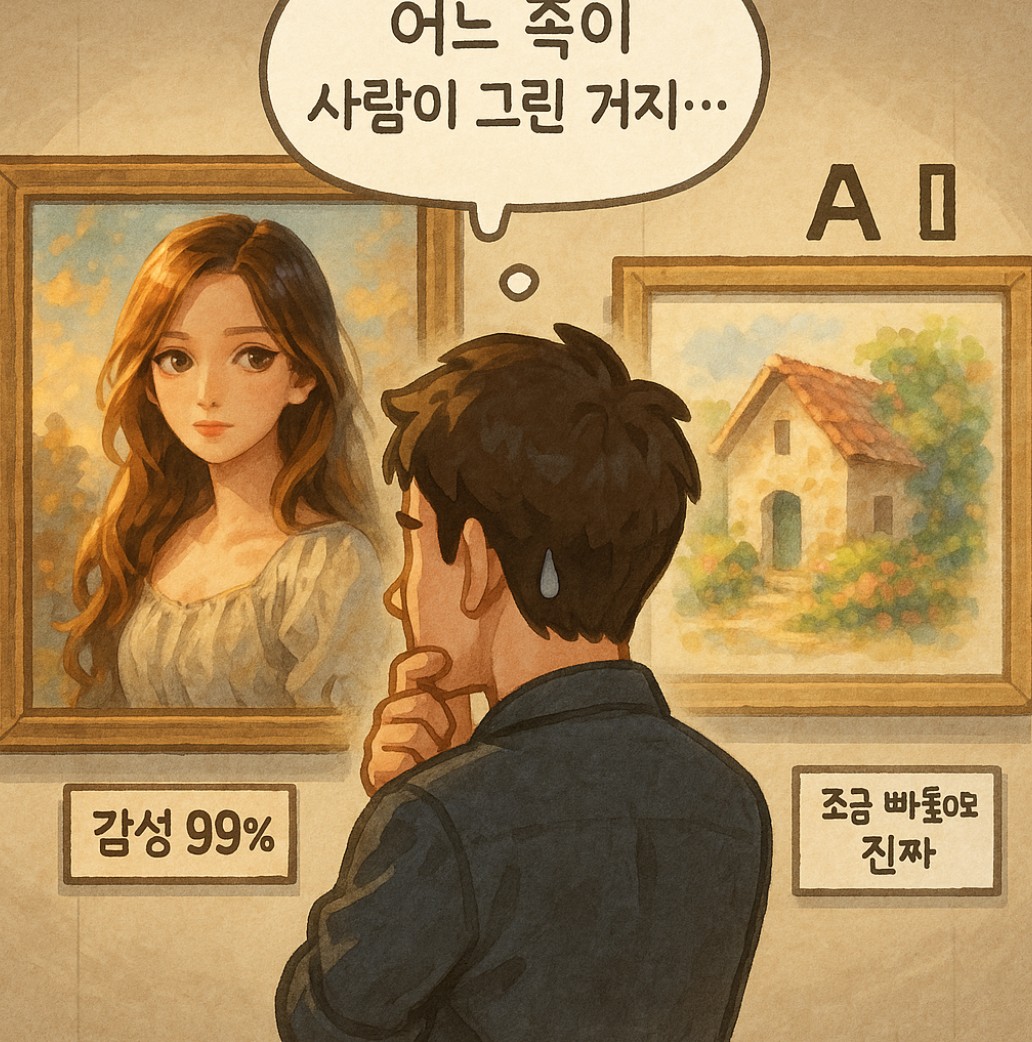
What Is AI Art?
AI-generated art refers to images created by machine learning models trained on massive datasets of photos, paintings, and designs.
Tools like DALL·E, Midjourney, and Stable Diffusion create images from text descriptions — almost like magic.
Can Humans Tell the Difference?
Short Answer: “Sometimes, but it’s getting harder.”
1. In the beginning, it was easy
-
6 fingers on a hand
-
Weird eye directions
-
Nonsense letters or numbers
-
Background distortions
These obvious flaws gave AI away.
2. But now?
-
Since around 2023, AI art has become incredibly detailed and accurate.
-
Portraits, landscapes, and food images often fool even professionals.
Interesting Experiments
🔎 MIT Study (2023)
Participants could only identify AI images with 61% accuracy — basically chance level.
🎨 Artists vs AI
Some illustrators say they can spot differences in texture or brushwork, but even that line is fading.
AI now mimics painterly strokes and lighting effects very well.
Key Differences (Still… for now)
| Criteria | Human Art | AI Art |
|---|---|---|
| Emotional nuance | Usually visible | Sometimes flat or exaggerated |
| Background detail | Simplified or symbolic | Over-rendered or chaotic |
| Hands, ears | Realistic | Still has occasional errors |
| Text rendering | Accurate | Often gibberish (but improving fast) |
As AI Improves...
Modern AI can now simulate intentional composition, light dynamics, and even emotional tone.
Some AI art feels more human than human, ironically.
The future may not ask, “Who drew this?”
It may ask, “Why was this drawn?”
Conclusion
Humans are losing the edge when it comes to visually detecting AI-made art.
The focus is shifting from form to intent — from “who made it” to “why it was made.”
Tags
AI art, artificial intelligence, image detection, real vs fake, generative AI, digital art, emotion in design