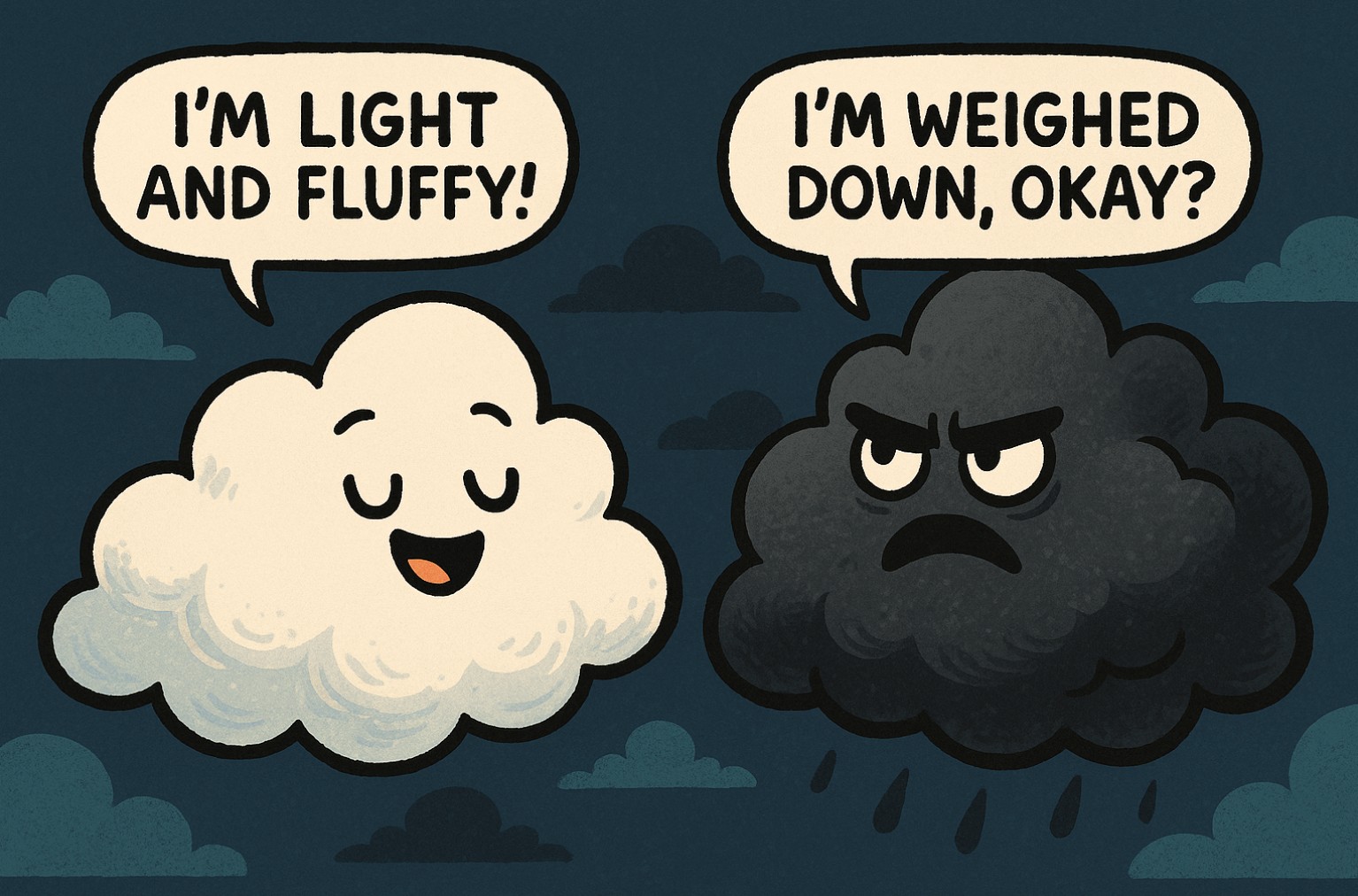
☁️ Definition: Clouds Are Made of Water Droplets
Clouds are formed when water vapor condenses into tiny liquid droplets or ice crystals.
They reflect and scatter sunlight, making them visible to our eyes.
🌤 White Clouds vs. Dark Clouds
1. White Clouds – Thin and light-scattering
-
Have smaller water droplets, evenly dispersed.
-
They scatter all wavelengths of sunlight evenly — so they appear white.
-
Often seen on sunny days: cumulus or stratus clouds.
2. Dark Clouds – Thick and light-blocking
-
Contain dense layers of water droplets, often signaling rain or storms.
-
They absorb and block sunlight, so from below they look gray or black.
-
Known as nimbostratus or cumulonimbus clouds.
🎨 So, Is There Something “Black” in a Dark Cloud?
Nope!
-
Dark clouds don’t contain anything black.
-
The darkness is purely due to the thickness and density of the cloud blocking light from passing through.
-
From above the clouds, even dark clouds look white!
🧠 Fun Facts
-
Pilots fly above storm clouds and see a bright, white “cloud ocean” from above.
-
Clouds change color at sunset due to longer light path and shifting wavelengths.
-
Dark clouds often hold enough energy to produce thunder and lightning.
🌍 Cultural Expressions
-
In English: white clouds = fair weather, dark clouds = approaching storm.
-
In Japanese: “黒雲 (kurogumo)” represents ominous signs.
-
In many cultures, dark clouds symbolize bad moods or danger metaphorically.
Sources
-
Korea Meteorological Administration
-
NASA Earth Science Education
-
The Weather Book by Lisa Mauris