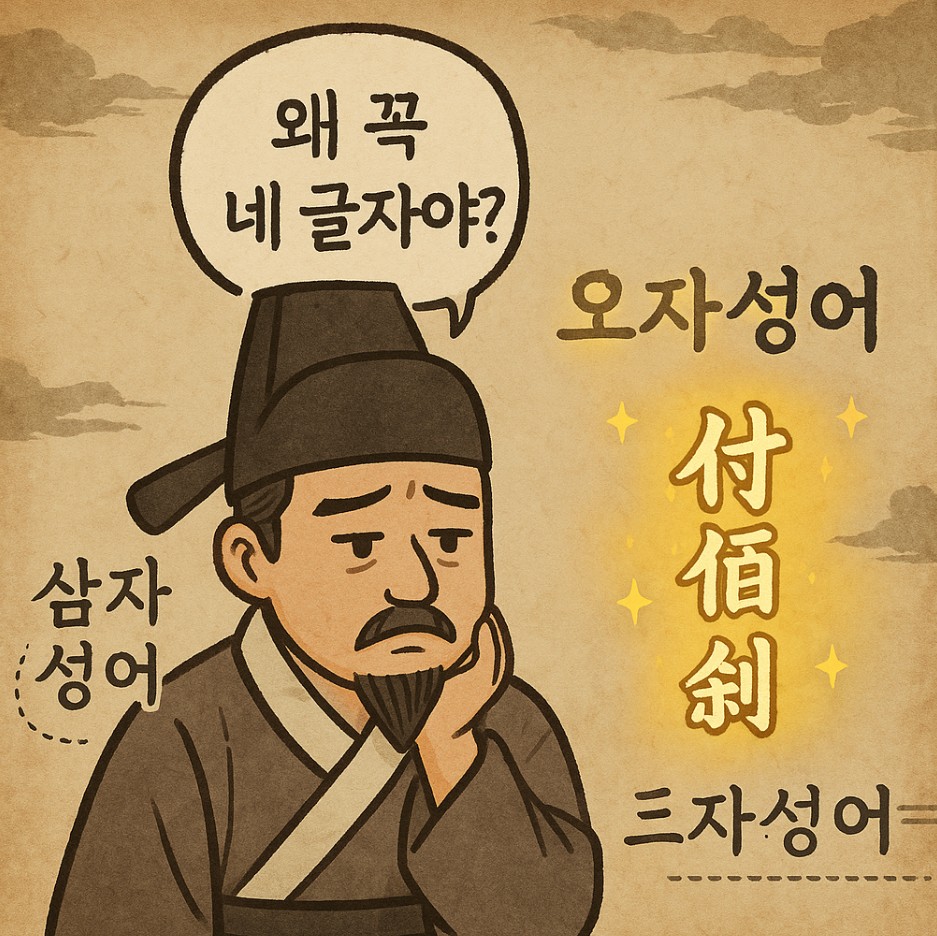
Definition and Origin of Four-Character Idioms
What Are Four-Character Idioms?
In East Asian languages,
a four-character idiom (四字成語) is a concise expression that conveys a full meaning or story using just four Chinese characters.
Examples:
-
九死一生 (Narrowly escaping death)
-
東問西答 (Giving an irrelevant answer)
Where Did They Come From?
Most originated from classical Chinese texts
such as the Analects, Mencius, Records of the Grand Historian, and others. They spread through Confucian cultures across
China, Korea, Japan, and Vietnam.
Why Exactly Four Characters?
Four Characters: The Perfect Formula
In Chinese, each character is one syllable and carries meaning.
Four characters create a rhythm, are easy to memorize, and still convey a full idea.
-
Example: 虎視眈眈 (Watching like a tiger)
-
Rhythm: Easily read in pairs (虎視 / 眈眈)
-
Structure: Balanced syntax — subject + verb or noun + adjective
Three Is Too Few 🤔
A 3-character expression often lacks completeness.
It can sound like part of a sentence rather than a stand-alone phrase.
Five Is Too Many 😌
Five characters feel awkward in rhythm and are harder to memorize.
They don’t carry the same punch.
Fun Fact
Japan and China Prefer Four Too
-
Japan uses 四字熟語 (yojijukugo) — almost identical to Korean 사자성어
-
In China, most idioms (成语) are also four characters. A few exceptions exist, but four remains dominant.
Four-Character Format Is Still Used Today
Even in modern ads or slogans:
"Honest taste, healthy choice" — mimicking the four-character feel.
Conclusion
Four-character idioms aren’t just tradition — they represent a perfect balance of meaning, rhythm, and memorability in East Asian language culture.
That’s why three- or five-character versions never took hold widely.
Tags
four-character idioms, Chinese characters, language culture, memory, East Asian philosophy, idioms, proverbs