What Is the Speed of Light?
How Fast Is Light?
The speed of light in a vacuum is approximately 299,792,458 meters per second — about 300,000 km/s. That means light reaches the Moon in just 1.3 seconds!
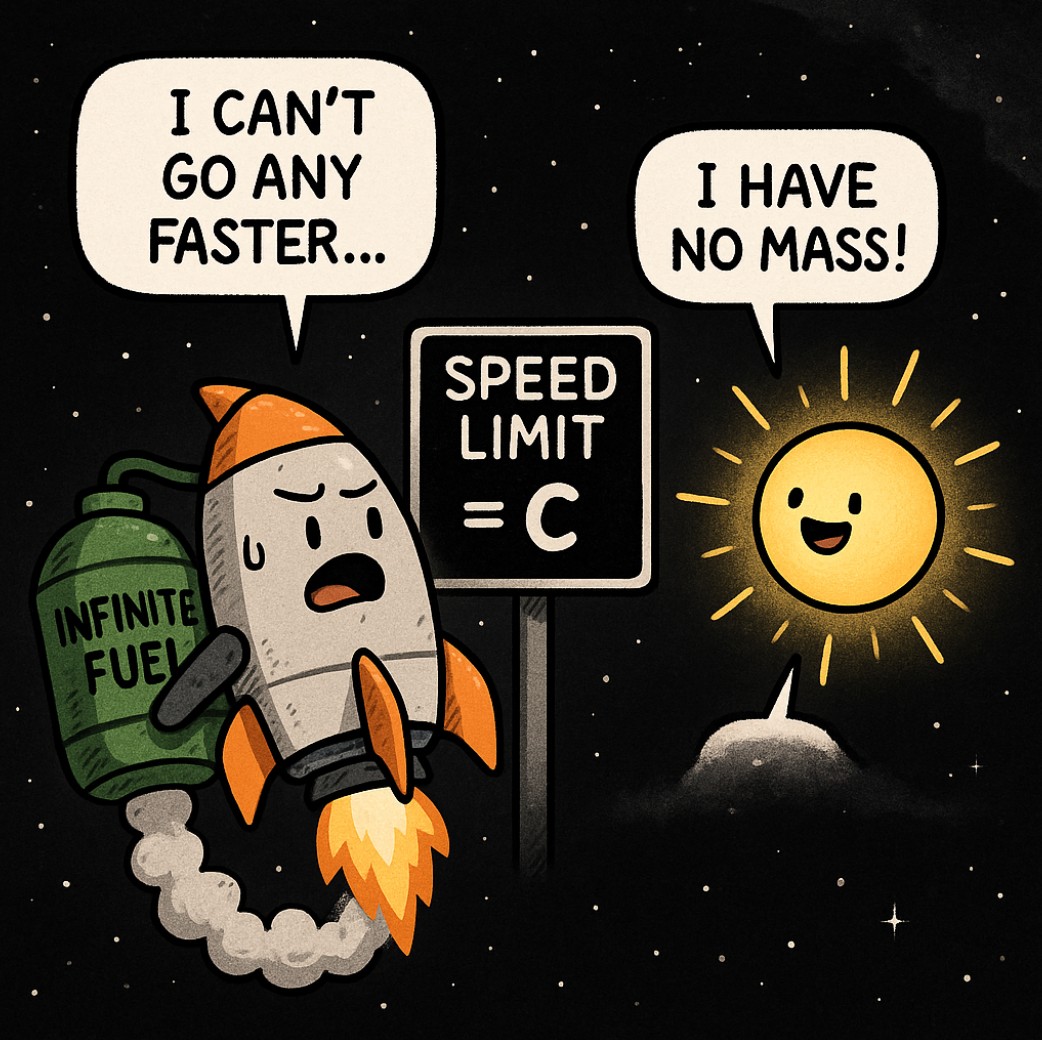
This speed, denoted as c, is not just fast — it’s the cosmic speed limit according to modern physics.
Where Does This Idea Come From?
Einstein’s Special Relativity (1905)
Einstein proposed that:
-
The laws of physics are the same in all inertial frames.
-
The speed of light is constant, regardless of the observer’s motion.
These two ideas lead to the conclusion that no object with mass can reach or exceed the speed of light.
Why Can’t Anything Go Faster?
The Mass Problem
As an object accelerates, its relativistic mass increases. Near light speed, this mass approaches infinity.
👉 To reach light speed, you would need infinite energy — physically impossible.
Light Has No Mass
Photons, the particles of light, have zero rest mass. That’s why they can move at light speed naturally.
Fascinating Facts
GPS Wouldn’t Work Without Relativity
-
GPS satellites orbit Earth at high speed.
-
Their clocks tick slightly slower, due to relativity.
-
GPS systems use Einstein’s equations to correct time differences.
✅ No relativity = No GPS!
Our Fastest Probe Is Still Super Slow
NASA’s Parker Solar Probe travels at ~700,000 km/h — just 0.2% of the speed of light.
What About Sci-Fi Stuff?
Wormholes, warp drives, and quantum teleportation are hypothetical or theoretical ideas. They don’t break light speed — they try to bypass it using tricks of spacetime.
Conclusion
The speed of light isn’t just fast — it’s a fundamental boundary built into the fabric of spacetime itself. It’s tied to energy, mass, and time.
Until proven otherwise, nothing in our universe can outrun light.
Tags
speed of light, relativity, Einstein, space limit, mass and energy, light speed, astrophysics