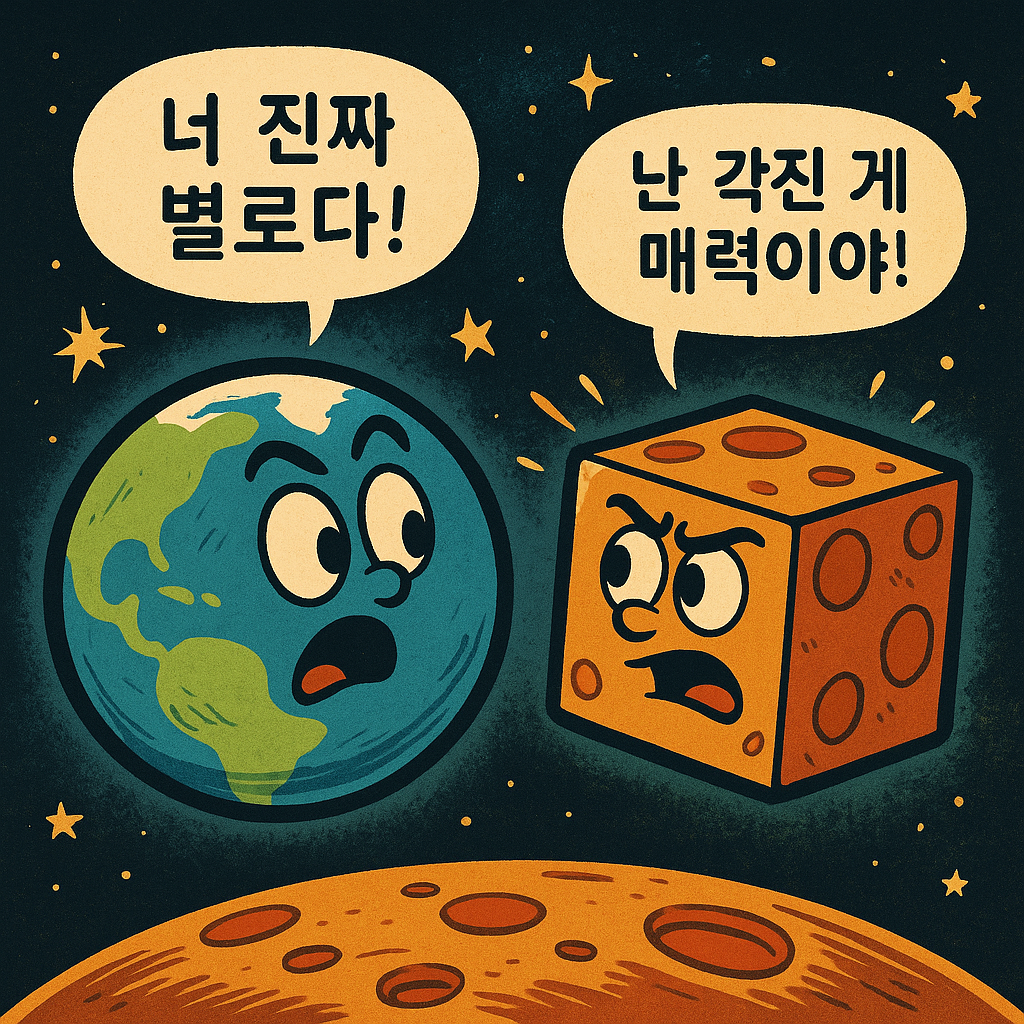
🌍 Definition: Planets Are Balls of Gravity
All planets and stars have massive gravity, pulling everything inward toward their center.
The result? A sphere — the most balanced shape.
That’s why most large celestial bodies become round naturally. The shape forms itself!
💫 Why Round? 3 Scientific Reasons
1. Gravity Pulls Equally From All Sides
-
Bigger objects have strong gravity that smooths out rough shapes.
-
So the larger it gets, the more rounded it becomes.
2. Spheres Are Energy-Efficient
-
A sphere has the smallest surface area for a given volume, which means stability and minimal energy loss.
3. Rotation Adds to the Shape
-
Planets spin. This causes slight bulging at the equator due to centrifugal force, but overall they remain round.
🔲 Square Stars? Probably Not.
-
In real physics, square-shaped stars are unstable.
-
The corners would collapse under gravity, making the shape round again.
But Wait...
-
Some neutron stars have microscopic “bumps” — like tiny mountains just a few millimeters high!
-
Theoretical simulations suggest a cube planet is barely possible, if made of ultra-strong material.
🧠 Fun Facts
-
Gas giants like Jupiter are a bit flattened spheres due to fast rotation.
-
Some asteroids look like potatoes or peanuts because they don’t have enough gravity to become round.
-
Square planets appear in games like Minecraft, but not in reality.
Sources
-
NASA Planetary Science Division
-
ESA "Why Planets Are Spherical"
-
Tyson, N.D., Astrophysics for People in a Hurry